For years, businesses had a fairly simple picture of Google Search.
Someone typed a few words.
Google displayed ten blue links.
Businesses competed to appear as close to the top as possible.
That version of Search still exists, but it is no longer the whole picture.
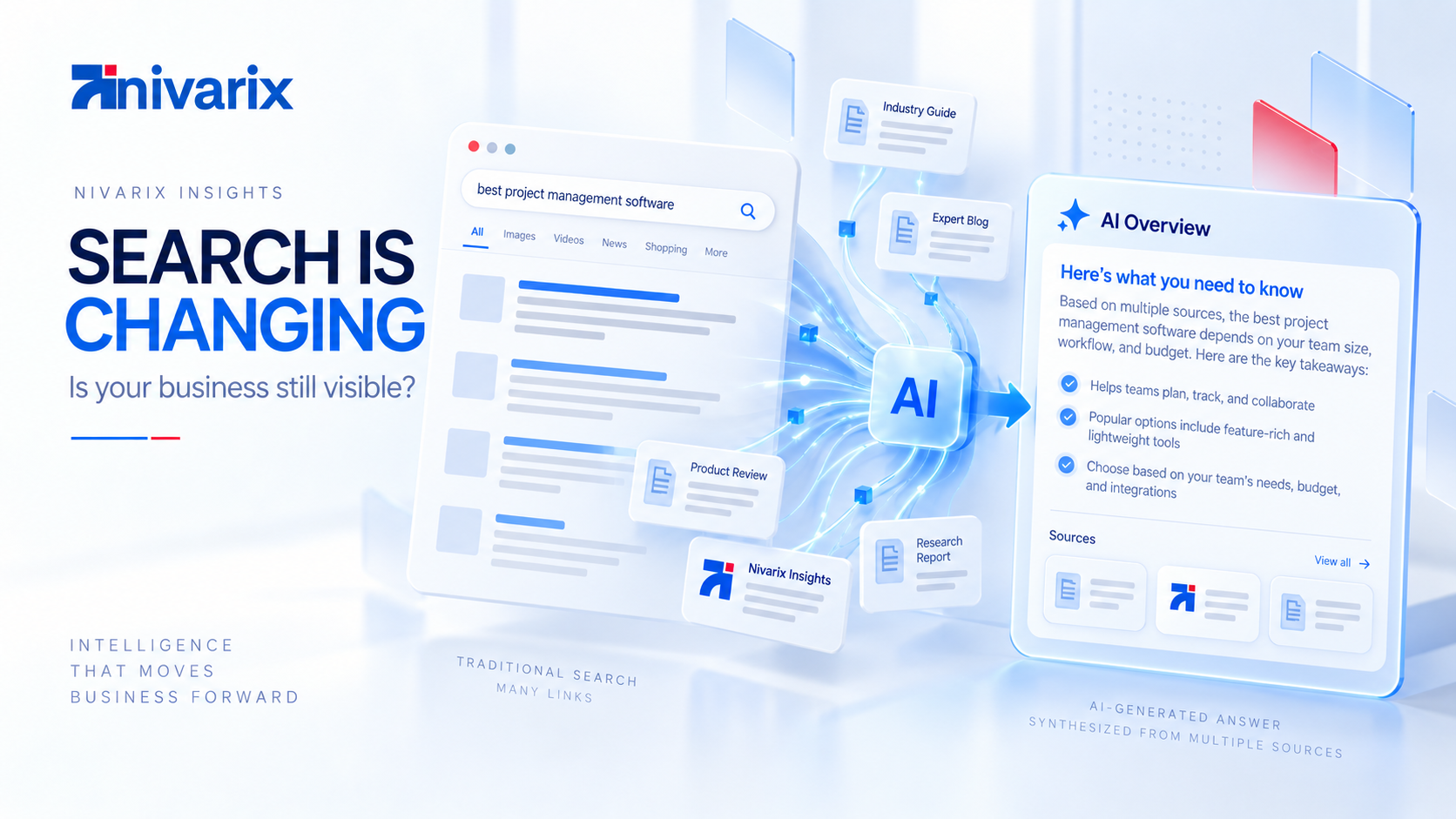
A customer researching a service today may see an AI-generated answer before they see the traditional organic results. They may continue the search as a conversation, ask follow-up questions, compare several options inside AI Mode and only visit a website once they have narrowed down what they want.
For businesses that depend on Google for leads, this creates an understandable concern:
If Google answers the question itself, will customers still visit our website?
There is no simple answer to that.
But there is one thing businesses should understand early.
SEO is not disappearing.
It is changing.
And according to Google's own guidance, many of the fundamentals that helped websites succeed in traditional Search still matter in AI Overviews and AI Mode. Google says its generative AI search experiences rely on its existing Search index, ranking systems and quality systems to retrieve information from the web. (Google for Developers)
So the question is not whether businesses should stop doing SEO.
The better question is:
What does good SEO look like when customers search with AI?
Google Search is becoming much more conversational
Think about how people used to search.
A business owner looking for inventory software might type:
inventory management software
Then perhaps:
inventory software for small business
Then:
best inventory software Nigeria
Each query happened separately.
AI search makes it easier to ask the actual question in someone's head:
We have three retail locations and currently manage stock using Excel. What type of inventory system should we use if the branches need separate stock but management wants one central dashboard?
That is a very different search.
Google says AI Mode is increasingly being used for longer, more complex questions and follow-up conversations. By May 2026, Google reported that AI Mode had surpassed one billion monthly users globally, while AI Overviews had more than 2.5 billion monthly active users. (blog.google)
This matters because businesses are no longer competing only for short keywords.
They are competing to be a useful source when Google needs information to answer complex questions.
Does traditional SEO still matter?
Yes.
Google is unusually direct about this.
Its current documentation says existing SEO best practices remain relevant because AI Overviews and AI Mode are connected to Google's core Search ranking and quality systems. (Google for Developers)
That means businesses should not abandon things such as:
- useful content
- crawlable pages
- clear site structure
- internal linking
- good page experience
- relevant titles
- descriptive headings
- fast websites
- mobile usability
- local business information
- quality images
- structured data where appropriate
The difference is that search intent is becoming broader.
A page may be discovered not only because it matches the exact words someone typed, but because it contains useful information related to one part of a much larger question.
Google refers to one of the techniques behind this as query fan-out.
Its AI systems can break a complicated request into related searches, retrieve relevant information across them and use those results to build an answer. (Google for Developers)
That has important implications for content strategy.
Stop writing only for keywords
Keywords still matter.
They tell you what customers are interested in.
They help reveal demand.
They help you understand the language people use.
But businesses can get into trouble when keyword research becomes the entire content strategy.
Imagine a software company discovers these searches:
AI automation for business
business AI automation
AI automation tools for companies
AI business process automation
business automation using AI
The old approach might have been to create five articles targeting five slightly different phrases.
That is becoming less useful.
Google specifically warns against producing large numbers of pages simply to capture every possible variation of a search. Its AI systems are designed to understand meaning beyond exact keyword matches. (Google for Developers)
A better article would answer the actual problem behind those searches.
For example:
Which parts of a business can realistically be automated using AI, and where should the company start?
That article can naturally discuss customer support, sales, reporting, inventory, administration and workflows.
It is more useful to the reader.
It also gives a search system more context to understand what the page is about.
The strongest content will contain something that is actually yours
This is where many company blogs fail.
Search for almost any business topic and you will find articles that say essentially the same thing.
Five benefits of AI.
Seven digital transformation trends.
Ten reasons your company needs software.
Everything sounds correct.
Nothing feels memorable.
And increasingly, nothing separates one company from another.
Google's 2026 guidance puts particular emphasis on what it calls non-commodity content.
That means content that adds something meaningful instead of simply summarizing information anyone could find or generate. Google specifically recommends original viewpoints, first-hand experience, expertise and useful information that goes beyond what already exists online. (Google for Developers)
For a business, that could mean showing what you have actually learned.
A logistics software company could explain the five most common mistakes it sees when businesses digitize dispatch operations.
A dental software company could discuss why appointment reminders alone do not solve patient no-shows.
A construction firm could explain what typically causes a renovation budget to change after work begins.
A cybersecurity business could publish anonymized examples of vulnerabilities it regularly discovers.
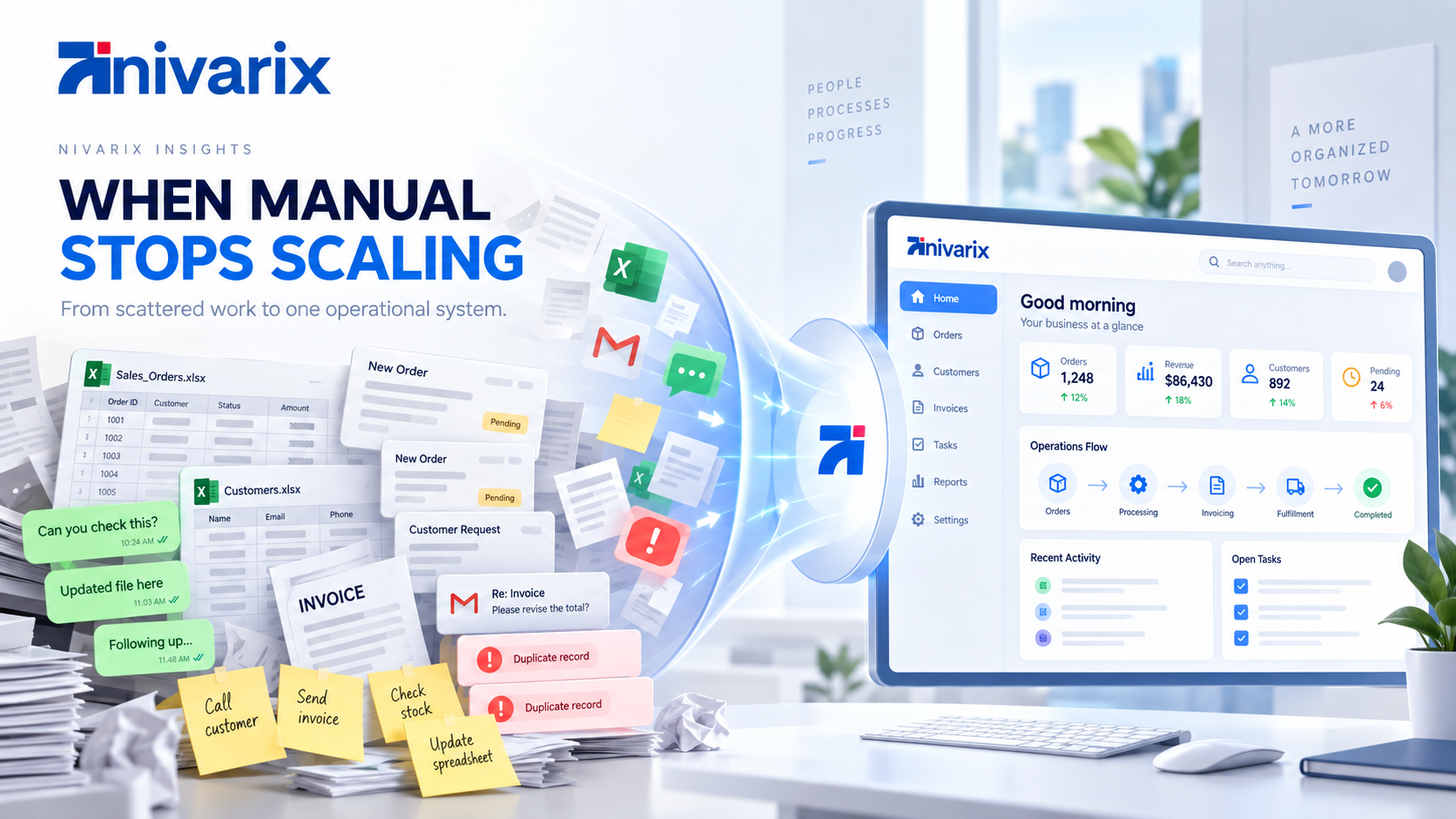
A software company like Nivarix might show how a fragmented workflow actually gets converted into an operational system.
For example:
Before

Website enquiry
      ↓
Email inbox
      ↓
Employee copies information
      ↓
Spreadsheet
      ↓
WhatsApp message
      ↓
Manual follow-up
Then:
After

Website enquiry
      ↓
Central customer record
      ↓
Automatic qualification
      ↓
Assigned owner
      ↓
Follow-up workflow
      ↓
Management reporting
The second half of that article contains experience.
It gives readers something they can use.
And it gives search systems something more valuable than another summary of information that already exists everywhere.
Answer the questions your customers ask before contacting you
A useful way to create content is to listen to sales conversations.
What does a potential customer usually ask?
Maybe:
How much does custom software cost?
Should we build our own system or use SaaS?
Can you add AI to software we already have?
Can our website connect to our CRM?
How long does it take to develop an internal platform?
Do we need a mobile app or is a web application enough?
Can we connect WhatsApp to our customer management system?
Those questions are already content ideas.
This is often better than sitting in a meeting trying to invent "SEO topics."
Your customers are effectively giving you the topics.
The job of the website is to answer them better than a salesperson could in a five-minute conversation.
Not because the website should replace the sales team.
Because a well-informed prospect arrives at the sales conversation much further along.
Give clear answers before giving long explanations
People do not want to search through twelve paragraphs to find a simple answer.
Neither traditional search nor AI search changes that.
If your article asks:
Can AI be integrated into existing business software?
Answer it immediately.
For example:
Yes. In many cases, AI capabilities can be added to existing software through APIs and integrations without rebuilding the entire platform. The right approach depends on your existing architecture, data, security requirements and the tasks you want AI to perform.
Then explain the details.
That structure works well for human readers because they can get the answer quickly and continue reading if they need more information.
Good business content should respect the reader's time.
Build depth around the problems you actually solve
Publishing one article about AI does not suddenly make a company an authority on artificial intelligence.
This is why a good content strategy needs clusters.
Imagine Nivarix publishes:
AI Agents for Business
Then:
How to Add AI to Your Existing Business Software
Then:
AI Agents vs Traditional Automation
Then:
What Is AI-Native Software?
Then:
How AI Can Improve Customer Support Operations
Then:
How Businesses Can Use AI With Their Existing Data
Each article solves a different question.
Together, they establish depth around the broader subject.
The same approach works with operational software.
You could have content about:
custom software,
SaaS,
business automation,
inventory systems,
CRM,
workflow management,
systems integration,
business dashboards,
and software modernization.
Then those pages connect naturally to one another.
This is useful for readers because they can continue learning.
It is also useful for search engines because the relationships between your pages become clearer.
Internal linking deserves more attention
Businesses regularly publish good content and then leave each article isolated.
That wastes an opportunity.
Suppose someone reaches an article explaining why spreadsheets become difficult to manage as a business grows.
Inside that article, you can naturally point them toward:
Custom Software vs SaaS
or:
How to Automate Repetitive Business Processes
or a relevant Nivarix service page.
That gives the reader somewhere useful to go next.
Internal links also help Google discover pages and understand how different parts of a website relate to each other.
Think about your website as a connected knowledge system, not a pile of pages.
Your service pages matter just as much as your blog
There is a common misconception that SEO means blogging.
It does not.
Imagine someone searches for:
custom software development company in Nigeria
They probably do not want a 3,000-word article explaining what custom software is.
They may be looking for a company.
Your service page should therefore clearly explain:
what you do,
who you do it for,
what types of systems you build,
how your process works,
your relevant experience,
what technologies or capabilities matter,
how engagement works,
and how someone can contact you.
Search intent matters.
Articles educate.
Service pages convert.
Case studies prove.
Product pages explain.
Company pages establish trust.
A strong SEO strategy needs all of them.
Technical SEO still matters because Google has to reach the content first
You can publish the best article in your industry and still create unnecessary problems if search engines cannot properly access it.
Google's AI search guidance says pages need to be indexed and eligible to appear in normal Search before they can appear in its generative AI features. It also continues to recommend crawlable pages, sound JavaScript implementation, good page experience and reduced duplication. (Google for Developers)
This matters particularly for modern websites built with JavaScript frameworks.
A beautiful interface is not enough.
Your development team should also pay attention to:
- crawlability
- indexing
- canonical URLs
- metadata
- robots directives
- XML sitemaps
- page speed
- mobile experience
- broken links
- redirects
- duplicate pages
- accessible navigation
- server responses
- image optimization
For businesses using frameworks such as Next.js, technical SEO should be part of the architecture from the beginning.
It should not be something somebody attempts to bolt onto the site six months later.
Structured data is useful, but it is not a magic AI switch
Structured data helps search engines understand certain information about a page and can make pages eligible for specific search features.
Examples include information relating to:
organizations,
articles,
products,
local businesses,
breadcrumbs,
and other supported content types.
That makes structured data worthwhile where it accurately represents what is on the page.
But there is an important distinction.
Google says there is no special structured data required to appear in AI Overviews or AI Mode. It also warns site owners not to overfocus on structured data as if adding more schema automatically produces AI visibility. (Google for Developers)
Use structured data correctly.
Do not treat it like a cheat code.
You do not need a special "AI version" of your website
As AI search has grown, a new industry has grown around telling businesses they need special files, formats and optimization tricks.
Some recommendations are useful.
Others are simply good SEO with a new name.
Google addressed this directly in 2026.
It says you do not need special AI markup, special Markdown pages or an llms.txt file to improve visibility in Google's AI search experiences. Google currently ignores llms.txt for ranking and visibility in Search. (Google for Developers)
It also says you do not need to break every article into tiny pieces just so an AI can understand it.
And you do not need to rewrite everything into awkward language designed for machines.
That is good news.
Your customers are still human.
Write for them.
What about GEO and AEO?
You may have seen terms such as:
GEO
Generative Engine Optimization
and:
AEO
Answer Engine Optimization.
These terms are being used to describe strategies for gaining visibility inside AI-generated answers.
There is useful thinking happening around how businesses can become more discoverable across different AI platforms.
But when it comes specifically to Google, businesses should be careful about anyone claiming that GEO requires abandoning SEO and adopting a completely separate set of secret techniques.
Google's current position is that optimizing for its generative AI search experiences is still part of SEO because those systems depend on the same underlying Search infrastructure. (Google for Developers)
So instead of asking:
How do we trick AI into mentioning our company?
Ask:
How do we become one of the most useful and trustworthy sources available when someone researches the problems we solve?
That is a much healthier long-term strategy.
Local businesses should not forget local search
AI search does not make your Google Business Profile irrelevant.
If anything, businesses need to make sure their basic information is accurate wherever customers might discover them.
Google specifically recommends maintaining Google Business Profile information for businesses that depend on local visibility because local business data can also surface in generative AI search experiences. (Google for Developers)
For a local company, that means paying attention to:
business name,
category,
location,
opening hours,
phone number,
website,
services,
photos,
and other relevant information.
If someone asks:
Which dental clinic near me is open on Saturday?
or:
Find a software company in Lagos that develops custom business systems
Google needs reliable information to work with.
Your website and your wider search presence should agree about who you are and what you do.
Images and video are becoming more important too
Search is increasingly multimodal.
Someone can search using text, images, files and other inputs.
Google's 2026 Search updates also emphasize deeper integration of visual information and different content formats into AI-powered results. (blog.google)
That gives businesses another reason to stop treating images as decoration.
Useful visual content could include:
screenshots,
original diagrams,
process illustrations,
before-and-after examples,
product demonstrations,
short videos,
charts,
and explanatory graphics.
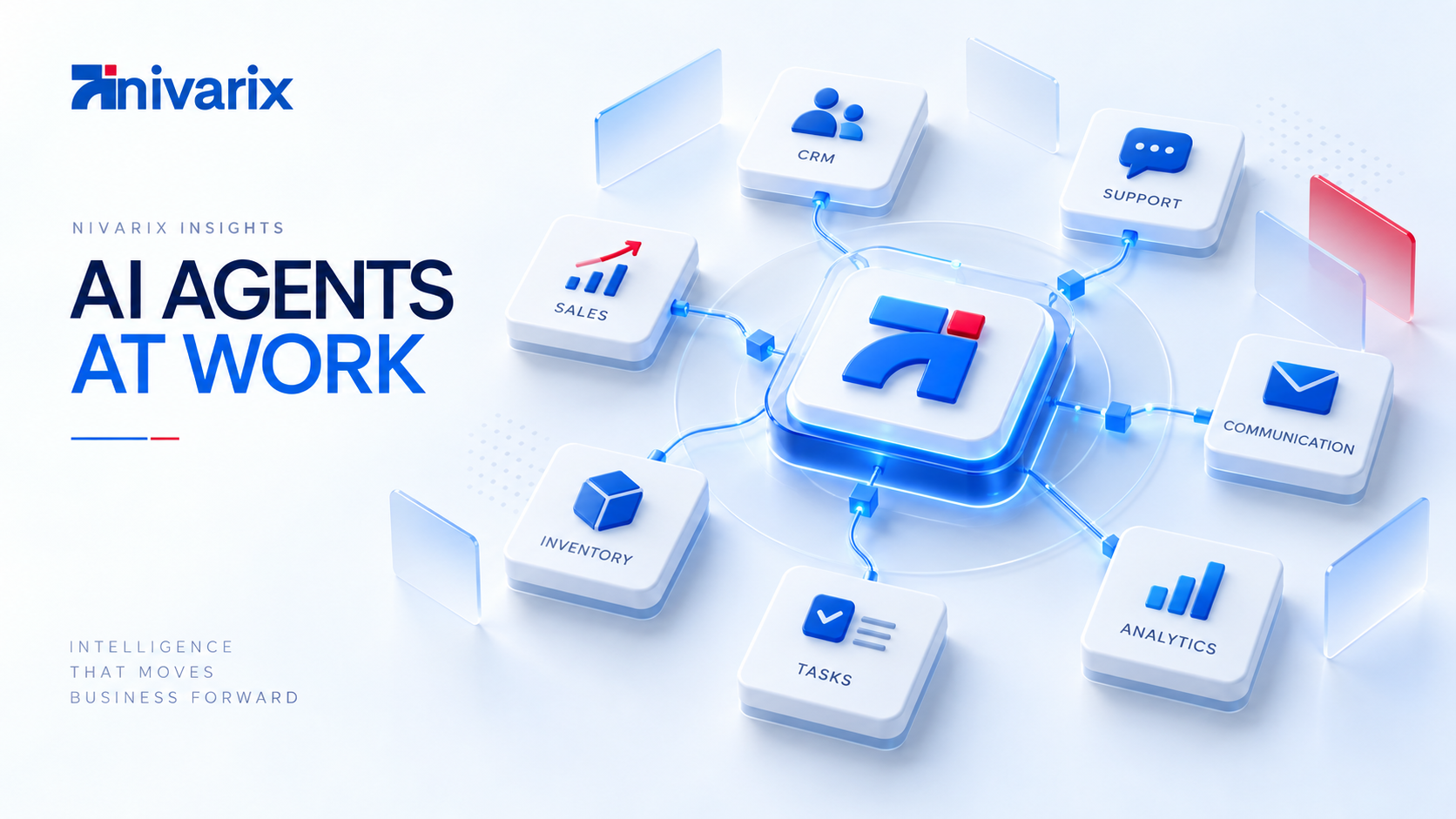
For Nivarix, for example, an article about AI automation could contain an original diagram showing how an AI agent connects to a CRM, database, payment service and support platform.
The visual actually teaches something.
That is much more valuable than adding a random stock image of a robot pointing at a hologram.
Your website still has to convince the person who clicks
There is a risk of becoming so focused on Google that businesses forget what happens after someone arrives.
A website can technically rank and still perform badly.
Imagine clicking a result and finding:
a slow page,
tiny text,
five popups,
generic copy,
no clear service information,
no proof,
no contact path,
and a site that barely works on mobile.
The ranking got the visitor there.
The experience lost them.
Google continues to recommend good page experiences, including mobile usability, sensible performance and making the main content easy to access. (Google for Developers)
Businesses should therefore measure more than rankings.
Ask:
Did people stay?
Did they read?
Did they visit another page?
Did they enquire?
Did they book?
Did they call?
Did they request a proposal?
Traffic without business outcomes can become a vanity metric.
Brand may matter more than businesses expect
Imagine two articles appear as sources inside an AI search result.
One comes from a website you have never heard of.
The other comes from a company you recognize.
Which one are you more likely to click?
Search visibility and brand building are becoming increasingly connected.
Google has also expanded ways for users to identify and follow preferred sources inside its AI search experiences. In 2026, it brought Preferred Sources into AI Overviews and AI Mode, allowing users to see more content from publications and sources they have chosen. (blog.google)
That makes a larger point.
SEO should not exist in isolation.
Your website content, LinkedIn presence, videos, social content, newsletters, thought leadership, case studies and customer experience can reinforce each other.
In July 2026, Google even expanded Search Console reporting so creators and businesses can understand how content published on platforms such as Instagram, TikTok, X and YouTube performs in Google Search and Discover. (Google for Developers)
The boundary between website SEO and broader digital visibility is becoming less rigid.
Measure AI visibility instead of guessing
Until recently, one of the biggest frustrations with AI search was measurement.
Businesses could see traditional Search Console data, but understanding how their site appeared specifically inside generative AI experiences was more difficult.
That changed in 2026.
Google introduced dedicated Generative AI performance reporting in Search Console in June and expanded it globally by August 31, 2026. The reports provide information such as impressions, pages appearing within generative AI results, countries, devices and performance over time. (Google for Developers)
Google's September documentation also confirms that AI Mode data now contributes to Search Console performance totals. (Google for Developers)
This gives businesses something much more useful than predictions.
Actual data.
You can start asking:
Which pages are being surfaced?
Which topics are gaining AI visibility?
Which countries are seeing our content?
Which articles are growing?
What should we improve?
What should we publish next?
That is how an SEO strategy should evolve.
Research.
Publish.
Measure.
Learn.
Improve.
What should businesses focus on in 2026?
If you strip away all the new terminology, the strategy is surprisingly sensible.
Understand what your customers are trying to solve.
Create genuinely useful pages around those problems.
Show expertise that belongs to your business.
Make information easy to understand.
Build technically sound websites.
Connect related content.
Keep important business information accurate.
Use original images and video where they improve the explanation.
Maintain useful service and product pages.
Measure what is actually happening.
And keep improving.
That will not guarantee that every page appears in an AI Overview.
Nothing can guarantee that.
Google itself states that meeting its technical requirements and recommended practices does not guarantee crawling, indexing or inclusion in Search results. (Google for Developers)
But it gives your business a far better foundation than chasing every new SEO trick that appears on social media.
SEO is becoming less about manipulating search and more about earning visibilityThis may ultimately be the biggest change.
When someone asks an AI search system a complicated question, there may be dozens or hundreds of possible sources it could use.
Why should yours be one of them?
Because your page answers the question well.
Because your website is accessible.
Because the information is current.
Because you have actual experience.
Because the content contributes something useful.
Because other pages on your website reinforce that expertise.
Because customers and search systems can clearly understand what your company does.
That is not radically different from what good SEO was always supposed to be.
The technology around it has simply become much more sophisticated.
Businesses that understand that distinction have an opportunity.
While competitors chase shortcuts, they can build something much harder to copy:
a website people actually trust.
Building websites for how people search now
At Nivarix Technologies, we do not treat SEO as a list of keywords added after a website has been developed.
Search visibility begins much earlier.
It influences site architecture, performance, content structure, metadata, structured data, internal linking, accessibility and the way information is presented to both people and search systems.
As Google Search becomes increasingly AI-driven, that foundation matters even more.
A modern business website should not simply look good.
It should be technically sound, easy to understand, useful to customers and structured for the way discovery is evolving.
If your website was built for the way people searched five years ago, this is a good time to review whether it is ready for how they search today.
Explore Nivarix Web Development & Digital Experience Solutions