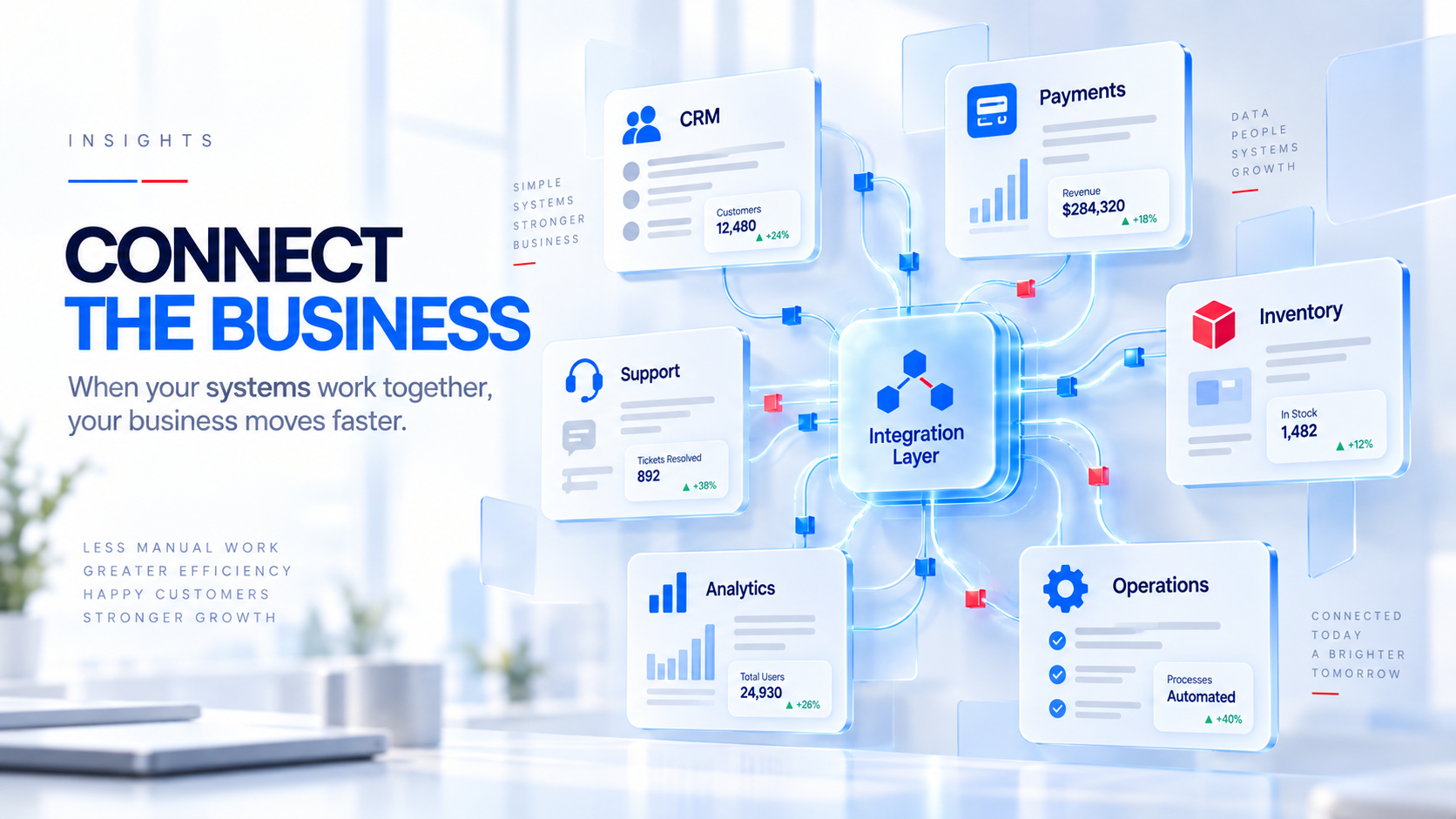

A customer places an order through your website. Someone copies the details into the inventory system, checks a bank notification, updates a spreadsheet and sends the customer a message. Every manual transfer creates an opportunity for delay, duplication or error.
An integration can reduce this work by letting applications exchange information. However, connecting two systems properly requires more than finding their API endpoints.
What determines API integration cost?
The main cost drivers are the number and quality of the systems involved, data mapping, authentication, frequency of synchronization, failure recovery, testing and ongoing provider charges. A one-way read-only connection is usually simpler than a two-way financial integration with audit requirements. Request separate quotes for discovery, implementation, testing, deployment and recurring support.
Choose the connection method based on the actual workflow
| Method | Suitable use | Important limitation |
|---|---|---|
| Ready-made connector | Common supported applications | May not cover special business rules |
| Scheduled API import | Periodic reporting | Data may not be immediately current |
| Webhook-driven integration | Timely event notifications | Must verify, deduplicate and recover missed events |
| Two-way API synchronization | Shared business records | Requires clear ownership and conflict handling |
| File exchange | Older software without usable APIs | Needs validation and controlled import processes |
Inspect each provider's current documentation and plan limits. A vendor may charge for API access or restrict operations at certain subscription levels. Do not assume the advertised presence of an API means it supports every required function.
Map the authoritative system before writing code
Imagine an online retailer connecting an ecommerce website, warehouse system and accounting package. The warehouse system might own stock quantities, the online store might own checkout orders, and the accounting package might own financial postings. Record the owner of each business decision. For example, checkout sends the order, the warehouse confirms stock and dispatch, and accounting determines whether the invoice posts. Show the exception path explicitly and give someone responsibility for recovery.
For each data field, establish the source, destination, permitted values, identifiers and update rules. Two systems may use different product codes or represent refunded orders differently. Moving those values without mapping them can corrupt reports while both applications appear to work.
Build for failure, not only the successful demonstration
A provider may be temporarily unavailable, rate limits may apply, credentials may expire, or a notification may arrive more than once. Store appropriate synchronization state and use controlled retries with backoff. For state-changing operations, design idempotency or equivalent duplicate protection. Check how your provider behaves before reusing a request identifier. The Stripe idempotent requests illustrates how a provider documents retry behaviour. Record failed events and provide a reconciliation procedure.
For example, receiving a payment event twice must not generate two invoices. The Stripe webhook delivery and retries explains duplicate event delivery and verification. If the accounting API fails after a transaction is recorded, a later retry should finish the required work without repeating the original charge. Keep sufficient audit information while avoiding unnecessary sensitive data in logs.
Estimate integration work by component
The table below is a hypothetical scope for a one-way order integration with a confirmation workflow. It is not a verified market price or official quotation.
| Work package | Example hours |
|---|---|
| Process mapping and API feasibility | 8 |
| Authentication and data mapping | 12 |
| Order synchronization | 24 |
| Retry and reconciliation handling | 16 |
| Integration testing and deployment | 16 |
| Handover documentation | 4 |
| Total | 80 |
At a hypothetical agreed engineering rate of ₦20,000 per hour, the implementation allowance would be ₦1.6 million, excluding provider fees, tax, and later support. A narrower connector may require less; a regulated multi-system workflow may need substantially more. Ask each supplier to quote the same scope.
Protect the data and accounts
Use only authorized connections and narrowly scoped credentials. Keep production secrets out of browser code and source repositories. Verify incoming messages using the provider's documented security mechanisms. Determine what personal information each system actually needs and restrict access to integration logs and administrative tools.
Business owners should control the provider accounts and understand the process for rotating credentials. A forgotten integration account can stop a critical workflow when a contractor leaves.
Integration acceptance tests
Test normal processing, duplicate events, invalid values, unavailable services, expired credentials, partial completion, large volumes within agreed limits and recovery after an outage. Compare totals across the authoritative systems before going live. Include monitoring and a manual recovery procedure for failed records.
Frequently asked questions
Can every application be integrated?
No. Available interfaces, permissions and data quality determine what is possible. File exports or a system replacement may be more appropriate in some cases.
Can integrations work in real time?
Often, with suitable provider capabilities, but clarify what delay is acceptable and how missed events are recovered.
Are API fees included in development costs?
Not automatically. Identify subscriptions, usage fees, cloud charges and support separately.
Connect your existing systems with a defined plan
Nivarix provides API and systems integration engineering. Begin with the software you currently use, the workflow you want to improve and the authoritative records each system maintains. A feasibility assessment can identify which connections are practical before development begins.
Discuss an integration assessment
Related guides and services
- Map records across your business systems
- Compare payment integration approaches
- Scope a WhatsApp website integration
- Plan long-term app maintenance
- Explore Nivarix systems integration
Sources
Checked 29 November 2026.
- Stripe webhook delivery and retries
- Stripe idempotent requests
- OWASP Application Security Verification Standard
Cover photograph by Field Engineer, via Pexels.