
A dental clinic and a logistics company both have customers.
They both collect payments.
They both manage employees.
They both send messages.
They both need reports.
So, at a very high level, they look similar.
Now spend one day inside each business.
The similarity disappears quickly.
The clinic needs appointments, patient records, treatment plans, recalls, prescriptions, clinical notes and perhaps insurance workflows.
The logistics company needs dispatch, drivers, routes, shipment status, proof of delivery and pricing based on locations or weight.
The basic business concepts may be the same.
The actual work is completely different.
That difference explains why industry-specific software, often called vertical software or vertical SaaS, is becoming more important.
Stripe describes vertical SaaS as software built around the needs of particular industries, from home services and auto repair to highly specialized markets. In 2026, Stripe said it was working with more than 16,000 platforms across these types of markets, with many expanding beyond basic software into payments, financial services and AI. (Stripe)
Businesses are increasingly asking a simple question:
Why should we spend so much time configuring generic software to understand our industry when software can be designed to understand it from the beginning?
That does not mean general-purpose software is disappearing.
Far from it.
But the closer software gets to the core operations of a business, the more industry knowledge starts to matter.
What is industry-specific software?
Industry-specific software is built for the workflows, terminology and operational requirements of a particular type of business.
For example:
Dental practice software might include:
- patient records
- appointment scheduling
- treatment plans
- clinical notes
- prescriptions
- recalls
- insurance
- dental inventory
Construction software might include:
- projects
- contractors
- budgets
- site reporting
- drawings
- inspections
- variations
- equipment
- progress tracking
Restaurant software might include:
- tables
- menus
- kitchen orders
- reservations
- inventory
- payments
- delivery
- staff shifts
The software does not begin with:
What features does every business need?
It begins with:
How does this particular type of business actually operate?
That is the key difference.
Horizontal software solves broad problems
The alternative is usually called horizontal software.
Horizontal tools solve problems found across many industries.
Think about:
- spreadsheets
- project management
- video conferencing
- cloud storage
- general CRM
- accounting
- communication
A construction company, dental clinic and technology company may all use the same email provider.
There is no strong reason for each industry to build a completely different email system.
That is where horizontal software is excellent.
The problem appears when a general tool moves deeper into an industry-specific workflow.
Imagine trying to run a dental clinic entirely inside a generic CRM.
Technically, you could create:
contacts,
pipelines,
custom fields,
tasks,
notes,
automations,
and calendars.
Eventually, though, the team starts building workarounds.
A contact becomes a patient.
A sales pipeline becomes a treatment plan.
A custom field stores medical information.
Tasks become recalls.
Files contain clinical records.
The CRM is technically flexible enough to do these things.
But flexibility is not the same as understanding the workflow.
The cost of "we can customize it"
One of the strongest selling points of general business software is customization.
That is valuable.
But there is a point where customization becomes a warning sign.
Imagine buying a general platform and immediately needing:
20 custom fields,
15 automations,
several plugins,
three external integrations,
multiple spreadsheets,
and a long document explaining how employees should use everything.
At that point, the question becomes:
Are we configuring software, or are we trying to invent our own industry system inside someone else's product?
This happens more often than businesses realize.
The original software may still be excellent.
It simply was not designed around that particular workflow.
Industry-specific software starts with many of those assumptions already built in.
Terminology matters more than it looks
Software feels much easier when it speaks the same language as the people using it.
Consider a clinic.
Employees naturally talk about:
patients,
providers,
appointments,
treatments,
procedures,
recalls,
prescriptions.
A generic system may instead use:
contacts,
users,
events,
tasks,
products,
follow-ups.
Those concepts can be mapped.
But employees constantly have to translate the software into their world.
Industry-specific software removes much of that translation.
A dentist should not have to mentally convert:
contact
into:
patient
every time they use the application.
This may sound like a small design detail.
It affects onboarding, usability and how naturally employees adopt the software.
The workflow already exists
Another advantage of industry-specific software is that many workflows do not have to be invented from zero.
Consider what happens when a patient books an appointment.
A specialized dental system may already understand:
Appointment booked
       ↓
Confirmation
       ↓
Reminder
       ↓
Patient arrives
       ↓
Check-in
       ↓
Consultation
       ↓
Treatment
       ↓
Invoice
       ↓
Recall
Those concepts belong naturally together.
A generic scheduling system may handle the first three steps perfectly.
After that, employees start switching systems.
That is the important distinction.
Industry-specific software often tries to cover a larger portion of the actual operational journey.
One industry can contain dozens of small rules outsiders never notice
This is where domain knowledge becomes valuable.
On paper, software requirements often look simple.
Take inventory.
Every business needs:
item,
quantity,
price,
supplier.
Then you speak to the people actually doing the work.
A dental clinic may want to know:
which branch has the material,
expiry date,
batch number,
which provider used it,
whether it is medication,
minimum stock level,
whether a central branch controls replenishment.
A restaurant may care about:
ingredients,
portions,
recipes,
wastage,
kitchen consumption,
supplier delivery,
food cost.
A construction company may care about:
site allocation,
equipment,
materials,
procurement,
usage,
contractors,
project budgets.
It is all "inventory."
But it is not the same inventory problem.
This is one reason software designed for one industry can feel significantly more complete.
The best industry software can reduce the number of applications a company needs
A business may originally solve its problems one at a time.
It buys scheduling software.
Then invoicing.
Then CRM.
Then inventory.
Then customer messaging.
Then reporting.
Then another application for something specific to the industry.
Before long, employees work across several systems.
Modern vertical platforms are increasingly trying to cover more of that stack.
Stripe's 2025 benchmark research across more than 200 vertical SaaS companies found that multiproduct platforms had larger addressable markets and grew faster than companies offering fewer capabilities. It also found payments, fintech and AI becoming important expansion areas for vertical platforms. (Stripe)
In practical terms, software may evolve from:
Scheduling software
+
Payments
+
CRM
+
Inventory
+
Messaging
+
Reporting
into:
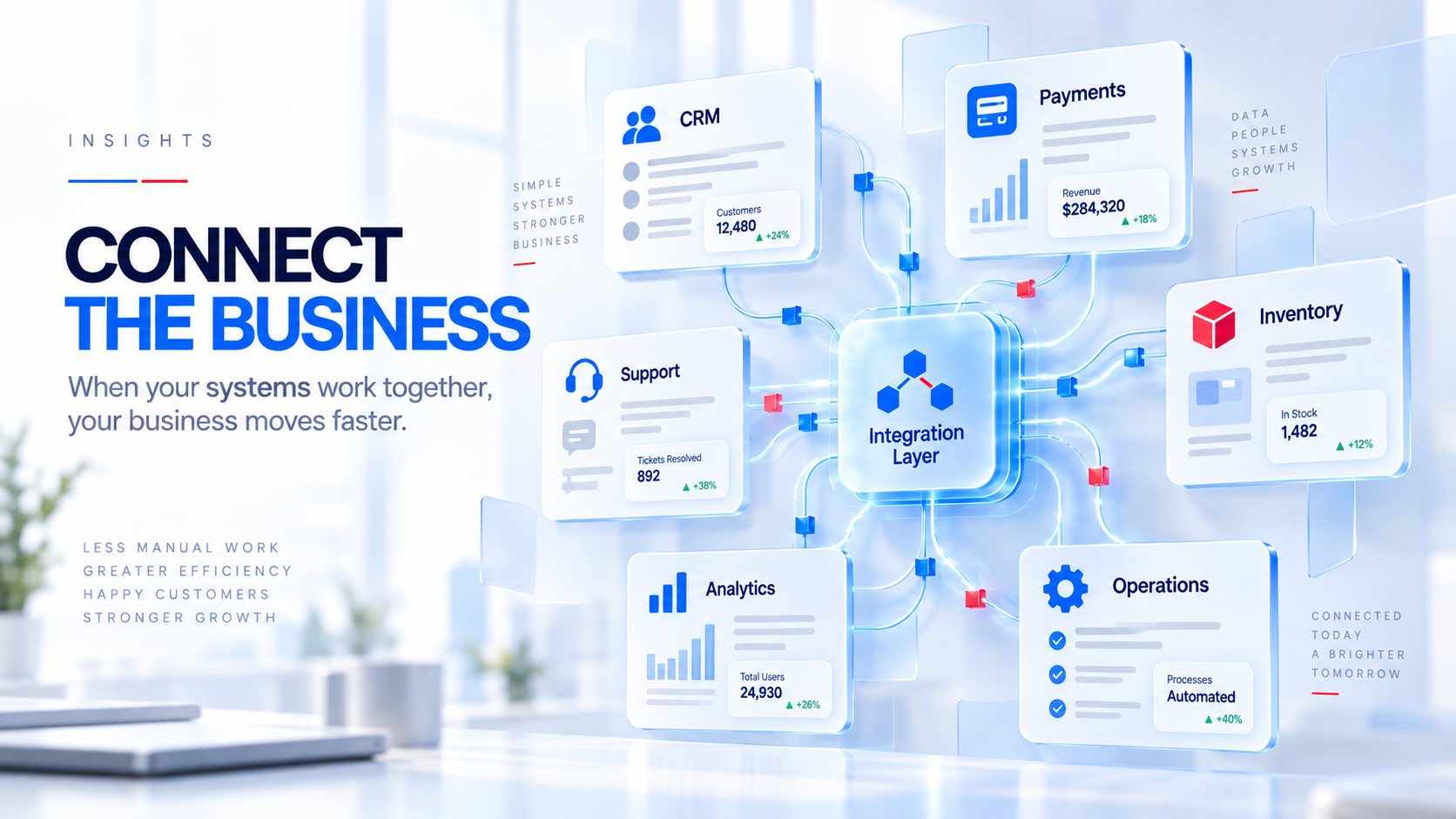
Industry Platform

Appointments
Customers
Payments
Inventory
Communication
Operations
Analytics
That does not mean one platform should literally replace everything.
Specialist tools and integrations will still matter.
But consolidating closely related workflows can reduce a lot of unnecessary friction.
Why healthcare is a good example
Healthcare shows clearly why general business software has limits.
A clinic is still a business.
It has customers, staff, payments, inventory and schedules.
But patients are not simply CRM contacts.
Healthcare workflows can involve:
- medical records
- patient privacy
- consultations
- prescriptions
- treatment history
- clinical documentation
- practitioner permissions
- appointments
- recalls
- insurance
The operational language and responsibilities are specific.
A generic customer database can store a person's name and phone number.
That does not make it a clinical system.
The deeper software moves into the actual delivery of healthcare, the more industry context matters.
The same thing happens in logistics
At a basic level, a logistics company receives an order and delivers something.
Simple.
Until the software needs to understand:
pickup location,
destination,
package type,
weight,
driver,
route,
delivery attempt,
tracking,
proof of delivery,
delivery fee,
failed delivery,
return,
cash collection.
Now the workflow is very different from the workflow inside a clinic.
Again, both businesses technically have:
customers,
orders,
employees,
payments.
But designing the same application for both quickly produces a very generic system.
Industry software can improve onboarding
Picture hiring a receptionist into a dental clinic.
You show them a generic CRM.
Before training them on the actual clinic process, you first have to explain:
We use Deals for treatments.
Activities means appointments.
Products actually means procedures.
This custom field means insurance.
Ignore this section because we don't use it.
For prescriptions, open this external app.
Now imagine giving them software where the navigation already says:
Patients
Appointments
Treatments
Prescriptions
Invoices
Recalls
Inventory
They still need training.
But the software matches the mental model of the job.
That can reduce unnecessary complexity.
Industry-specific software can also encode best practices
Good vertical software often reflects patterns learned from many companies in the same sector.
For example, a restaurant platform may already understand the relationship between:
orders,
kitchen preparation,
inventory,
payments,
and tables.
A construction platform may understand:
projects,
subcontractors,
documents,
budgets,
and site activity.
This can be valuable because every new customer does not need to design those relationships from scratch.
But there is an important caution.
Industry-specific does not automatically mean good.
A poorly designed vertical product is still poor software.
Some industry systems are old, difficult to use and expensive.
Specialization alone does not guarantee quality.
Businesses still need to evaluate the product carefully.
Compliance can make specialization more valuable
Some industries have requirements that do not apply to ordinary businesses.
Healthcare.
Financial services.
Insurance.
Legal services.
Government.
Education.
Certain areas of manufacturing.
Depending on the country and sector, software may need to support:
data retention,
audit history,
privacy,
access control,
industry documentation,
approval rules,
regulatory reporting.
A general tool can sometimes be configured to meet those requirements.
A specialist product may already have them built into the architecture.
This is one reason industry depth can become a competitive advantage for software vendors.
Industry-specific software is especially interesting in African markets
There is another dimension that matters for businesses in Nigeria and other African markets.
Software can be industry-specific and still be poorly matched to the local environment.
A product built for a US business may understand the industry perfectly but assume:
different payment systems,
different taxes,
different addresses,
different communication habits,
different currencies,
different customer behaviour,
different internet reliability,
or different operating structures.
This creates another layer of specialization.
Not simply:
software for clinics
but potentially:
software for how clinics actually operate in this market.
The same applies to:
retail,
agriculture,
logistics,
professional services,
hospitality,
and education.
Local payment infrastructure is an obvious example.
A Nigerian business may expect things such as:
bank transfers,
local card payments,
Paystack or Flutterwave integrations,
Naira pricing,
WhatsApp communication,
multi-branch operations.
A business should not need to fight its software every day because the application assumes a completely different operating environment.
AI makes industry knowledge even more important
This becomes particularly interesting when AI enters the picture.
A generic AI assistant may understand what an invoice is.
An industry-specific AI system can understand why a particular invoice exists, what happened before it and what normally happens next.
Consider two prompts.
Generic AI
Customer has not paid. Write a reminder.
Useful.
Now imagine AI connected to an industry platform.
Industry-aware AI
The system knows:
the customer's history,
what service was delivered,
which agreement applies,
whether there is an active complaint,
the invoice value,
the salesperson responsible,
and the company's collection process.
Now the AI can provide a much more useful action.
Andreessen Horowitz highlighted this opportunity when examining AI inside vertical SaaS. Their analysis argued that AI can allow industry-specific software companies to take on work previously too complex for software, including tasks across customer service, sales, operations and finance. (Andreessen Horowitz)
This may become one of the strongest advantages of vertical software.
The software already understands the workflow.
AI gives it more ability to participate in that workflow.
Think about a dental clinic using AI
A generic AI assistant could:
draft an email,
summarize text,
or answer common questions.
Useful.
An AI system connected to dental practice software might eventually help with:
appointment enquiries,
recall lists,
patient communication,
schedule gaps,
inventory alerts,
treatment explanations,
administrative summaries,
follow-up preparation.
The difference is not necessarily a better AI model.
It is better context.
That is the same principle we explored in our article about AI-native software.
AI becomes more useful when it understands the environment in which the work happens.
Industry-specific software is also becoming more platform-like
Early vertical SaaS products often solved one narrow problem.
Today, many are expanding.
Stripe's 2026 vertical SaaS observations show platforms moving beyond their original software functions into areas such as payments, lending and other financial services. (Stripe)
For a business customer, this can mean fewer disconnected systems.
For the software provider, it creates an opportunity to become more deeply embedded in day-to-day operations.
Think about the progression:
One useful tool
      ↓
Industry management software
      ↓
Operational platform
      ↓
Payments and financial services
      ↓
AI and automation
      ↓
Industry operating system
Not every company will follow that path.
But it explains why vertical software is receiving so much attention.
The deeper the platform understands the industry, the more problems it can potentially solve.
There is a risk of becoming too specialized
Industry-specific software also has disadvantages.
A product can become so opinionated that businesses cannot adapt it to their own processes.
Not every dental clinic operates identically.
Not every logistics company prices deliveries the same way.
Not every retailer manages branches the same way.
Good vertical software therefore needs a balance.
It should understand the industry deeply.
But it should still allow meaningful configuration.
For example:
Industry defaults
+
Configurable workflows
+
Custom fields
+
Integrations
+
Business-specific rules
That is often stronger than either extreme.
Too generic, and the software does not understand the business.
Too rigid, and the business cannot make it its own.
Do you need vertical software or custom software?
These are not the same thing.
Industry-specific software is usually a product built for many companies inside one sector.
Custom software is built specifically for one organization.
Imagine 1,000 dental clinics.
Many of them share:
appointments,
patients,
treatments,
billing,
recalls.
A strong dental platform can serve that shared need.
One particular dental group may then have a unique operating model involving:
50 branches,
centralized procurement,
unusual pricing,
special insurance processes,
custom reporting,
and complex approval rules.
At that point, the company might need:
industry software,
custom development,
or a combination of both.
This is why software decisions should be based on how far your requirements differ from what the market already provides.
What about horizontal software?
There is no reason to throw it away.
In fact, many strong technology stacks combine horizontal and vertical software.
For example:
Google Workspace
        +
Industry Platform
        +
Accounting Software
        +
Payment Provider
        +
Custom Integrations
The industry system handles the specialized workflow.
Horizontal tools handle common functions.
This is often a better strategy than forcing one application to do absolutely everything.
How to tell if generic software is holding your business back
Look at employee behaviour.
Not the software brochure.
Employees reveal whether a system really fits.
Ask:
Are people constantly exporting data to Excel?
Are critical workflows handled outside the software?
Do employees rely heavily on WhatsApp because the platform cannot handle an important process?
Are there dozens of custom fields?
Do new employees need a long explanation of what each field "actually means"?
Are several plugins required to perform basic industry functions?
Do employees repeatedly enter the same information?
Does management struggle to get industry-specific reporting?
Are customers experiencing friction because your software cannot support the workflow they expect?
If several of those are true, the issue may not be employee discipline.
Your software may simply be too generic.
How to evaluate industry-specific software
Specialized software should not get an automatic pass simply because it knows your industry.
Look carefully at the actual product.
Does it cover your core workflow?
Write down how work moves through your business.
Then compare the software to that process.
Do not start with a list of features.
Start with the workflow.
Is it modern enough to grow with you?
Some specialist platforms have excellent domain knowledge but outdated architecture.
Check:
- API availability
- integrations
- mobile experience
- security
- performance
- cloud infrastructure
- automation
- reporting
- export capabilities
Can you access your data?
Ask this before signing anything.
Can you export records?
Does the product provide APIs?
What happens if you eventually leave?
Does it support your local environment?
Consider:
currency,
payments,
tax,
communications,
address formats,
regulations,
and regional business practices.
Can it be configured?
Your company will have differences.
The software should understand the industry without assuming every company operates identically.
How well does it integrate?
No serious business runs one piece of software.
Integration matters.
Stripe's current work with vertical platforms is partly focused on exactly this broader ecosystem, where specialized software increasingly connects payments, financial products, AI and other services rather than remaining an isolated application. (Stripe)
Where custom development fits
Sometimes a good industry platform gets you 80 percent of the way there.
That may be enough.
Other times, the missing 20 percent contains the process that actually makes your company different.
This is where custom development can complement industry software.
For example:
Industry Platform
       ↓
Custom Customer Portal
       ↓
Custom Operations Workflow
       ↓
Payment Provider
       ↓
Business Intelligence
You do not rebuild everything.
You build the part that creates unique value.
This is closely related to the hybrid approach we discussed in Custom Software vs SaaS.
Buy what the market already does well.
Build what is specific to your advantage.
Integrate everything properly.
Why this matters for software product companies too
The trend toward specialization is not only important for businesses buying software.
It is also important for founders building products.
A startup does not always need to create:
the next CRM for everyone.
There may be a stronger opportunity in creating:
a CRM for property managers,
a platform for dental clinics,
operations software for logistics businesses,
practice management for law firms,
inventory software for pharmacies,
or workflow software for a particular type of manufacturer.
The market is smaller.
But the problem can be much clearer.
Customers may also be more willing to pay when the software solves several painful parts of their work instead of one generic problem.
Stripe's benchmark data found that vertical platforms expanding into multiple products can increase their addressable market and improve growth, which helps explain why many vertical vendors are broadening into larger industry platforms rather than remaining single-feature tools. (Stripe)
The real opportunity is understanding the business deeply
Technology is becoming easier to build.
AI is helping software teams create products faster.
Cloud infrastructure is accessible.
APIs provide building blocks for payments, communication, authentication, maps and many other capabilities.
That means one of the hardest things to copy may increasingly be:
understanding how an industry really works.
Not what the industry's website says.
Not what somebody assumes from the outside.
The actual work.
What happens on Monday morning?
What goes wrong?
What employees repeatedly complain about?
Where do customers wait?
Which process depends on one person's memory?
Where does money get lost?
What information gets copied manually?
What causes mistakes?
What does management wish it could see?
That knowledge is what turns generic technology into useful business software.
The future may be fewer generic tools and more connected industry platforms
Businesses will continue using horizontal software.
Email is not going anywhere.
Spreadsheets are not disappearing.
General accounting, communication and productivity tools will continue to be valuable.
But deeper operational workflows are becoming more specialized.
The software running a clinic does not have to look like the software running a construction company.
The software managing a restaurant does not have to pretend that a table booking is the same as a sales opportunity.
The software coordinating farm produce does not need to model inventory exactly like a fashion retailer.
The more technology enters the actual operation of a business, the more those differences matter.
Industry-specific software acknowledges something simple:
Businesses may share basic functions, but they do not all work the same way.
Good software should feel like it understands your business
There is an experience people have when they use genuinely suitable software.
They do not need someone to explain why the product works a certain way.
The workflow makes sense.
The language makes sense.
The information shown at each stage makes sense.
The system anticipates problems that are normal in that industry.
Employees spend less time working around the software.
That should be the objective.
Not specialization for the sake of specialization.
Better fit.
Building software around the realities of an industry
At Nivarix Technologies, we believe software becomes much more valuable when it reflects how people actually work.
Sometimes that means selecting and integrating an existing industry platform.
Sometimes it means extending one.
Sometimes a business has requirements specific enough to justify custom operational software.
And sometimes there is an opportunity to build an entirely new vertical product around an underserved industry.
In each case, the technology should begin with the same question:
How does this business really operate?
Only then should we decide what software it needs.
Explore Nivarix Industry Software & Product Engineering