
Over the last few years, almost every software company has found a way to put the letters AI somewhere on its website.
AI-powered CRM.
AI-powered accounting.
AI-powered support.
AI-powered analytics.
AI-powered everything.
Sometimes that description is completely justified.
Sometimes the AI feature is a button that rewrites an email.
And sometimes it is simply a chatbot placed in the corner of an application that otherwise works exactly the same way it did five years ago.
There is nothing wrong with adding useful AI features to existing software.
The problem begins when businesses confuse:
software that contains AI
with:
software designed around AI.
Those are not necessarily the same thing.
The term increasingly being used for the second category is AI-native software.
IBM describes AI-native products, companies and workflows as those designed with AI as a core component rather than AI being added later as a supporting feature. (IBM)
That sounds simple.
In practice, it can change everything from the user interface to the software architecture and even the way work happens inside the business.
So what exactly is AI-native software?
AI-native software is software designed with artificial intelligence as a fundamental part of how the product operates.
The AI is not simply a feature sitting beside the main system.
It can influence:
- how users interact with the software
- how information is retrieved
- how workflows are executed
- how decisions are supported
- how repetitive work is automated
- how different systems communicate
- how the application adapts to context
- how employees complete tasks
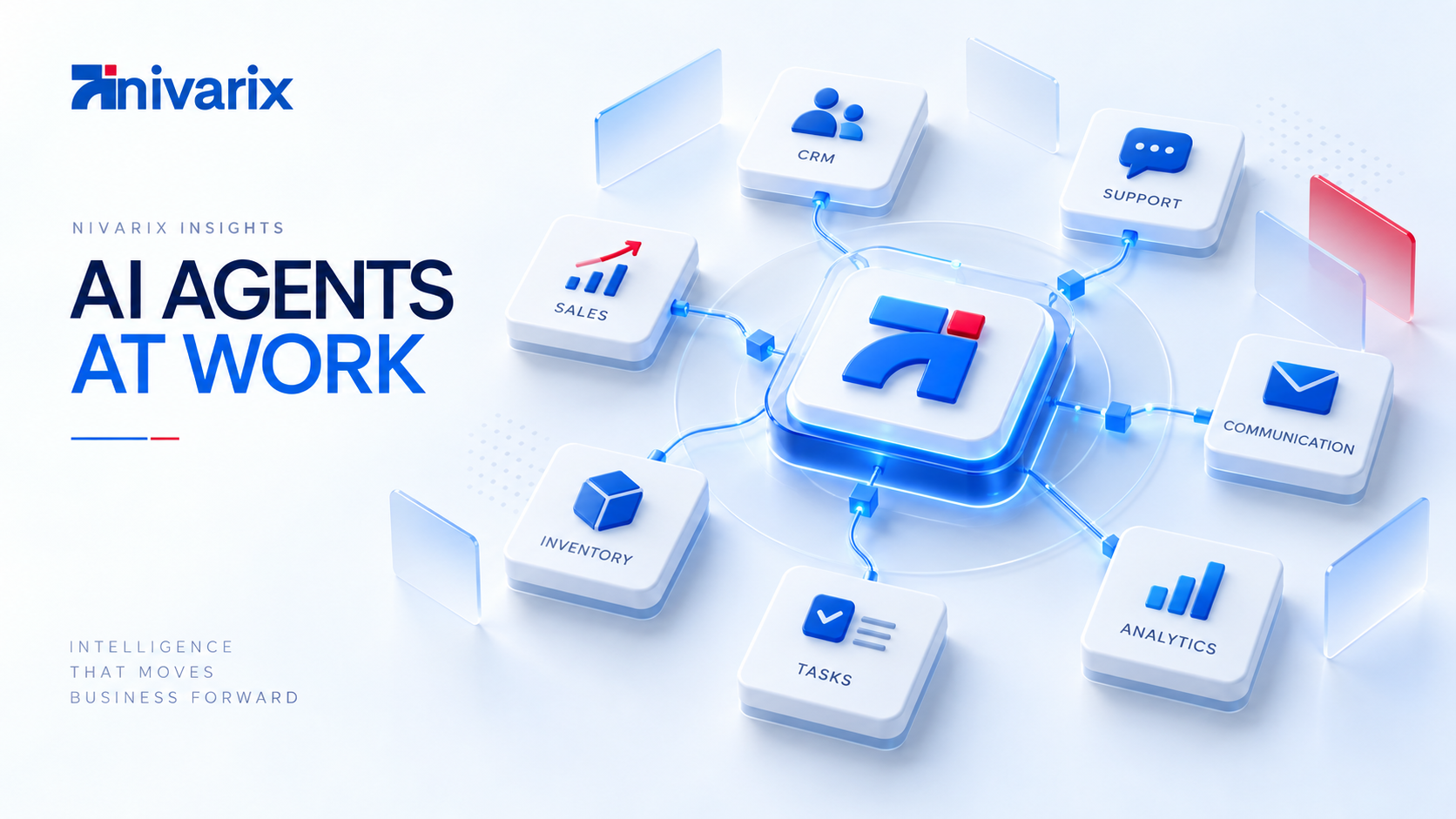
Microsoft describes a similar transition through what it calls agentic business applications.
In this model, traditional business processes still exist, but AI assistants become part of the interface, agents help orchestrate workflows and an intelligence layer connects information across the organization. (Microsoft)
That is a much deeper change than adding a chat box.
Think about the difference this way
Consider a traditional CRM.
A salesperson logs in.
They search for a customer.
They open the customer record.
They review previous activity.
They check outstanding tasks.
They read recent emails.
They decide what to do next.
They write the follow-up.
Then they update the CRM.
The software stores information.
The employee does most of the thinking and coordination.
Now imagine a more AI-native CRM experience.
The salesperson opens the customer.
The system already understands:
- what happened recently
- which opportunities are active
- what the customer has asked about
- which commitments are outstanding
- whether the account may be at risk
- what action is likely to be useful next
It might say:
This customer requested revised pricing three days ago. No response has been sent. Their contract expires next month. Here is a draft response based on the previous discussion.
The salesperson reviews it.
Makes a change.
Sends it.
The software then updates the opportunity and schedules the appropriate follow-up.
The database still matters.
The CRM still matters.
The employee still matters.
But the relationship between the employee and the software has changed.
The system is no longer only recording work.
It is beginning to participate in the work.
AI-powered and AI-native are not always the same thing
These terms are often used interchangeably in marketing, so businesses should look beyond the label.
A product might genuinely use AI without being AI-native.
For example, imagine an accounting application that has existed for fifteen years.
The company adds a feature:
Generate invoice description with AI
Useful?
Yes.
AI-powered?
Yes.
AI-native?
Probably not in any meaningful sense.
The central workflow remains unchanged.
The AI is an enhancement.
Now imagine another accounting platform designed so users can ask:
Which customers are likely to create cash-flow problems next month?
The system can inspect authorized financial data, understand payment histories, identify unusual patterns, explain what it found and prepare follow-up actions for the finance team.
It might then monitor those accounts automatically.
That begins to look much more AI-native.
The intelligence is connected to the actual operating model of the application.
Why the chatbot became everyone's first AI feature
Chat is an obvious interface for AI.
People already understand conversation.
Instead of creating new menus, buttons and dashboards, a company can simply add:
Ask anything.
That can be useful.
For some products, chat may remain an important part of the experience.
But it also created a misconception:
AI = chatbot.
It does not.
The most valuable AI may never appear inside a chat window.
Consider an ecommerce business.
AI could:
identify unusual orders,
predict inventory shortages,
categorize customer enquiries,
detect duplicate records,
summarize support cases,
recommend replenishment,
identify high-risk transactions,
or route operational problems.
None of those tasks necessarily require a chatbot.
The AI might simply operate behind the scenes.
That is one reason the discussion is moving from AI assistants toward agents and agentic workflows.
Google defines agentic workflows as AI-driven processes where agents can reason about a goal, use tools and perform multi-step tasks rather than simply follow a fixed automation script. (Google Cloud)
The five layers of AI-native software
A useful way to understand AI-native software is to look at the layers beneath the interface.
1. Context
An AI system becomes dramatically more useful when it understands the environment in which it is working.
A generic AI model does not automatically know:
who your customers are,
what your pricing rules are,
which employee has permission to approve something,
what happened with a particular order,
what your internal policies say,
or what inventory is currently available.
AI-native software connects intelligence to context.
That context may come from:
- databases
- CRM records
- documents
- emails
- operational systems
- customer history
- application state
- policies
- analytics
- user permissions
OpenAI's current enterprise work places heavy emphasis on this connection between AI, company context and business tools. Its August 2026 Enterprise Signals report found that organizations with deeper AI adoption were increasingly connecting agents to company information, tools and repeatable workflows rather than limiting AI to general assistance. (OpenAI)
Without context, AI can still be impressive.
With context, it becomes useful to the business.
2. Tools
Information alone is not enough.
Suppose an AI assistant knows that an invoice is overdue.
What happens next?
In traditional software, the employee takes over.
They open another system.
Find the invoice.
Find the customer.
Prepare the message.
Send it.
Schedule another reminder.
An AI-native system can potentially have approved tools such as:
getInvoice()
getCustomer()
prepareReminder()
sendEmail()
createTask()
updateCRM()
Now the AI can participate in the workflow.
This is one of the biggest differences between generative AI and agentic software.
OpenAI describes modern agents as systems that can use company tools and perform actions, while organizations define which actions are allowed and when human approval is required. (OpenAI)
3. Reasoning
Traditional software is usually deterministic.
If this happens:
do that.
For example:
IF invoice_due = true
THEN send reminder
There is nothing wrong with this.
In fact, normal automation is often preferable when the rule is simple.
AI becomes useful when the situation requires interpretation.
For example:
This invoice is overdue. Should we send the standard reminder?
The answer may depend on:
the customer's history,
the value of the invoice,
whether there is an open complaint,
whether the customer normally pays late,
whether a salesperson is already discussing the payment,
and whether the account is strategically important.
A capable AI system can consider that context and recommend a different next step.
That does not mean it should automatically make every decision.
It means software can now handle situations that previously required a person simply because they were too ambiguous for traditional rules.
4. Action
This is where the system moves from:
AI that knows
to:
AI that does.
An AI-native application might:
create a task,
update a record,
send a message,
schedule an appointment,
prepare a quotation,
retrieve a document,
assign a case,
or trigger another workflow.
Google Cloud has been describing this transition as part of the rise of the agentic enterprise, where agents increasingly move beyond basic assistance and begin orchestrating real business processes. (Google Cloud)
For businesses, this may ultimately be more important than improvements in chatbot quality.
The biggest productivity gains often come from reducing the number of small actions employees must manually coordinate.
5. Learning and improvement
Traditional software changes when developers release an update.
AI systems introduce another layer.
Organizations can evaluate:
where AI succeeds,
where it makes mistakes,
where employees override recommendations,
which cases require escalation,
and which workflows produce measurable improvements.
These signals can be used to improve the system.
That does not necessarily mean the AI independently retrains itself every night.
Often, the process is controlled.
Teams review performance, adjust instructions, improve tools, change rules or update knowledge sources.
OpenAI's enterprise agent platforms emphasize ongoing evaluation and optimization rather than treating an agent as something that is configured once and forgotten. (OpenAI)
That mindset is important.
AI software is not simply launched.
It is operated.
A chatbot can still be part of AI-native software
The argument here is not:
Chatbots are bad.
That would be wrong.
A conversational interface can be extremely powerful.
The question is what happens behind the conversation.
Imagine two systems.
System A
Customer:
When will my order arrive?
Chatbot:
Please provide your order number.
Customer provides it.
Chatbot:
Please contact our customer care team for assistance.
The company technically has AI chat.
It has not improved very much.
System B
Customer:
When will my order arrive?
The system identifies the authenticated customer.
Retrieves their active order.
Checks fulfillment status.
Reads the latest delivery event.
Recognizes that the package is delayed.
Explains the delay.
Provides the current estimate.
Creates an internal follow-up if the shipment exceeds a predefined threshold.
That may still look like a chatbot.
But underneath the interface is:
context,
tools,
business logic,
permissions,
integration,
and action.
That is the difference.
AI-native software should understand the user, not simply the prompt
Traditional software usually expects users to understand its structure.
To complete a task, you need to know where the correct menu is.
For example:
Customers
    ↓
Accounts
    ↓
Reports
    ↓
Outstanding Balance
    ↓
Filter
    ↓
30+ Days
An AI-native interface can begin from intent:
Show me customers with invoices more than 30 days overdue.
The software determines how to retrieve the information.
This does not mean menus disappear completely.
Some tasks are faster with buttons, forms and tables.
The larger idea is that users increasingly should not have to understand the internal structure of software just to accomplish a business goal.
This shift is already influencing how major software vendors think about business applications.
Microsoft's 2026 strategy describes AI assistants as a new interface layer, with agents helping move work through business processes beneath that interface. (Microsoft)
AI-native does not mean replacing normal software engineering
This is an important point.
Sometimes AI discussions create the impression that everything should now be probabilistic.
That would be a mistake.
Your payment calculation probably should not depend on an AI model guessing the answer.
Neither should:
tax calculations,
account balances,
inventory counts,
authorization checks,
financial ledgers,
or access permissions.
Normal application logic still matters.
Databases still matter.
APIs still matter.
Validation still matters.
Good AI-native systems combine different approaches.
For example:
AI understands the request
        ↓
Application validates permission
        ↓
AI chooses approved tool
        ↓
Deterministic business logic executes
        ↓
Database records result
        ↓
AI explains outcome
AI handles interpretation.
Software handles rules.
The database maintains reliable state.
That combination is much stronger than asking an AI model to control everything.
Your business data becomes much more important
The AI model may be extremely capable.
But if it cannot understand what is actually happening inside the business, its usefulness has limits.
Imagine asking:
Which customers are likely to stop buying from us?
The answer requires information.
Purchase history.
Support complaints.
Payment behaviour.
Engagement.
Contracts.
Recent communication.
If that information is spread across seven systems with inconsistent customer IDs, the AI project quickly becomes a data project.
Google Cloud makes this point in its current agentic data strategy.
It notes that generic AI systems often lack the enterprise context needed to reason accurately about company information and highlights data access, context and granular governance as central parts of agentic applications. (Google Cloud)
AI-native software therefore needs good data architecture.
There is no shortcut around it.
An AI-native system should know its boundaries
Imagine giving an intelligent employee a job.
You would not simply say:
Here is access to the company. Do whatever you think is best.
You would define responsibilities.
AI systems need the same discipline.
For example:
AI may:

Read customer history
Search company policy
Create support tickets
Prepare responses
Update support status
But:
AI may not:

Issue refunds above ₦100,000
Delete customers
Change bank details
Approve contracts
Access payroll information
For sensitive actions, the system might require approval.
AI prepares action
       ↓
Employee reviews
       ↓
Approve / Reject
       ↓
System executes
This is not a weakness.
It is good system design.
AI-native does not mean autonomous at all costs.
AI should appear where it creates value
One mistake companies make is placing AI everywhere because they want customers to notice it.
Every text box suddenly has a sparkle icon.
Every page has:
Ask AI
Every dashboard has:
Generate with AI
Eventually the product becomes noisy.
AI-native design should almost be the opposite.
AI should appear naturally where it reduces effort.
Consider a customer-support platform.
Instead of adding ten AI buttons, the system could simply:
summarize the conversation automatically,
retrieve relevant customer information,
suggest a useful reply,
identify urgency,
and show the next best action.
The employee experiences a smarter workflow without constantly thinking:
I am using AI now.
The technology disappears into the experience.
That is usually a sign of mature product design.
What does an AI-native customer experience look like?
Imagine an insurance portal.
Traditional software asks the customer to:
select the claim type,
fill twelve fields,
choose a category,
upload the correct document,
select the affected policy,
and navigate several screens.
An AI-native experience might begin:
Tell us what happened.
The customer explains.
The software extracts the relevant information.
It asks only for what is missing.
It identifies the policy.
It explains which documents are required.
It validates the information.
It creates the claim.
The same business process exists.
The interface has changed around the customer's goal.
This can happen in many industries.
Healthcare
Instead of navigating several menus, staff can ask for the relevant patient or operational information within their permitted access.
Logistics
An operations manager can ask:
Which deliveries are most likely to miss today's target?
Retail
Management can ask:
Which products should we restock before the weekend?
Professional services
A system can summarize project history before an employee joins a client meeting.
Financial operations
Finance can investigate unusual transactions or prepare account follow-ups.
The pattern is the same.
The software begins from the user's objective.
AI-native software can also act before someone asks
This is an even more significant change.
Traditional software waits.
You log in.
You search.
You click.
You ask.
An intelligent system can monitor what is happening and surface something when it matters.
For example:
Three high-value customers have invoices more than 45 days overdue.
Or:
This product is likely to run out before the next supplier delivery.
Or:
A customer who normally orders every month has not ordered in 60 days.
Or:
Five appointments tomorrow have not been confirmed.
The system becomes proactive.
That is much closer to what businesses actually want from technology.
They do not necessarily want more dashboards.
They want important things to stop getting missed.
The difference between automation and AI-native automation
Traditional automation is incredibly valuable.
For example:
New form submitted
       ↓
Send confirmation email
There is no reason AI needs to be involved.
Now imagine:
New enquiry submitted
       ↓
Understand what customer needs
       ↓
Determine business unit
       ↓
Check opportunity value
       ↓
Review existing customer history
       ↓
Select appropriate sales route
       ↓
Prepare personalized response
       ↓
Assign responsible employee
That workflow contains ambiguity.
The next step may differ depending on context.
This is where AI can complement normal automation.
Good AI-native software knows when to use:
rules
and when to use:
reasoning.
AI-native does not mean every business needs completely new software
This is especially important for established companies.
You may already have:
an ERP,
CRM,
internal platform,
accounting system,
inventory application,
customer portal,
or industry-specific software.
Becoming more AI-native does not automatically mean replacing all of them.
You can introduce AI gradually.
For example:
Stage 1
Add intelligent search and summarization.
Stage 2
Connect AI to selected business data.
Stage 3
Allow AI to prepare actions.
Stage 4
Automate low-risk actions within clear rules.
Stage 5
Introduce agents that coordinate across several systems.
That evolution may be much more practical than one enormous rebuild.
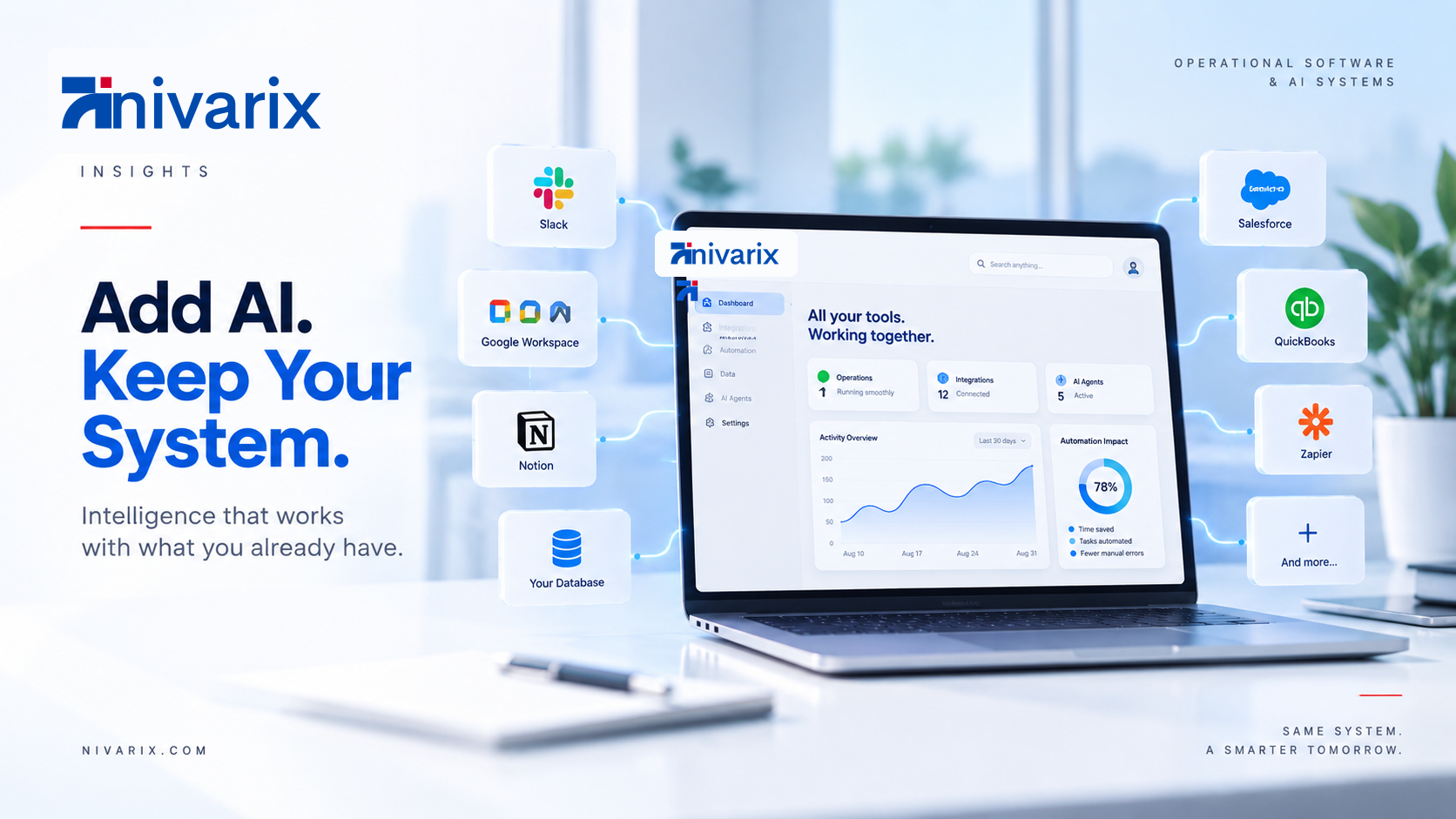
We discussed this more deeply in How to Add AI to Your Existing Business Software Without Rebuilding Everything.
How do you know if an AI feature is actually useful?
Forget the label.
Measure the work.
Ask:
Did it reduce the number of steps?
Did employees save time?
Did customers get answers faster?
Did error rates improve?
Did revenue increase?
Did operating cost decrease?
Did the company become easier to manage?
Could one employee now handle more work without becoming overwhelmed?
Those are useful measurements.
Not:
We launched five AI features this quarter.
A company can add twenty AI features and create very little value.
Another company can automate one painful workflow and produce a major operational improvement.
A practical test for AI-native software
If you are evaluating software that claims to be AI-native, ask:
Does the AI understand business context?
Or is it essentially a generic model inside the application?
Can it work with actual application data?
Can it retrieve information relevant to the user's task?
Can it take useful actions?
Or does it only generate text?
Does it respect permissions?
Can different users access only what they are allowed to see?
Can important actions require approval?
Especially where financial or operational consequences are significant.
Is the AI integrated into the workflow?
Or is it a separate feature users have to remember to open?
Does the system improve a measurable outcome?
This may be the most important question.
If nobody can explain the value, the AI label does not matter.
What AI-native software means for business leaders
Executives do not need to become machine-learning engineers.
But they should understand that this technology may change how companies buy and design software.
Previously, a software procurement conversation might ask:
Does the platform have the features we need?
Increasingly, businesses may also ask:
Can the system understand our context?
Can its agents work with our existing tools?
Can it automate workflows?
Can we define approvals and permissions?
Can it integrate with our company data?
Can the AI be evaluated and monitored?
What happens when the business process changes?
Those are very different questions.
What AI-native software means for software companies
Software companies also need to think beyond:
What AI feature should we add?
A better question is:
If we designed this workflow today, knowing what AI can do, would we design it the same way?
Often the answer will be no.
Why should a customer manually enter information the system can reliably extract?
Why should an employee search through ten screens if they can express the goal naturally?
Why should someone manually prepare the same report every Monday?
Why should staff monitor hundreds of records looking for exceptions?
Why should a customer wait for an employee to answer something the system already knows?
These questions can reveal where AI genuinely changes the product.
The future may contain fewer screens, not more
Software has spent decades adding menus.
Every new capability gets another page.
Another tab.
Another settings screen.
Another dashboard.
AI creates the possibility of moving in the opposite direction.
A user might simply say:
Set up the campaign for all customers who bought product A last month but haven't ordered again.
The software can identify the segment.
Show the proposed audience.
Prepare the campaign.
Request approval.
Schedule it.
Several screens may still exist behind the process.
The user does not necessarily need to navigate all of them.
Microsoft has described part of this shift as moving from applications that are primarily operated through traditional interfaces toward experiences where assistants and agents increasingly mediate how work gets done. (Microsoft Advertising)
That could become one of the biggest changes in software design since mobile.
AI-native software still needs humans
The most useful vision is not software replacing everybody.
It is software becoming more capable so people spend less time operating software.
Think about how much knowledge work today consists of:
searching,
copying,
checking,
summarizing,
routing,
formatting,
updating,
and reminding.
These tasks are necessary.
They are rarely the reason the employee was hired.
If software can handle more of that coordination, people can spend more time on:
judgment,
relationships,
strategy,
creative decisions,
negotiation,
leadership,
and unusual problems.
OpenAI's recent examples of AI-native organizations show agents being used in practical workflows such as onboarding, account management and developer integrations rather than being limited to standalone chat experiences. (OpenAI)
That is probably a more realistic picture of AI-native work.
Not humans disappearing.
Humans spending less time doing work that software can increasingly coordinate.
Adding a chatbot is easy. Redesigning the workflow is harder.
This is why genuine AI transformation is difficult.
The model may be the simplest part.
The business still has to answer:
What should the AI know?
Where is that information?
Which system owns the truth?
What actions should it perform?
Which actions need approval?
What happens when it is uncertain?
Who is responsible when something goes wrong?
How will performance be measured?
How does the AI fit into the employee's existing workflow?
Those are product, operational and architectural questions.
This is why buying an API key is not the same as having an AI strategy.
Start with work, not AI
Businesses considering AI-native software should begin with a simple exercise.
Look at an important workflow.
For example:
Customer asks for quotation
       ↓
Employee gathers requirements
       ↓
Employee checks pricing
       ↓
Employee prepares document
       ↓
Manager approves
       ↓
Quotation sent
       ↓
Employee follows up
Now examine each step.
Could software understand the requirements?
Could it retrieve pricing?
Could it prepare the quotation?
Which discounts require approval?
Could it automatically track whether the customer responded?
Could it remind the salesperson?
Could it update the CRM?
Suddenly you are not talking about:
adding AI.
You are redesigning the workflow around what modern software is capable of doing.
That is the more interesting conversation.
AI-native should mean better business, not more AI
There will be businesses that successfully implement AI without ever describing themselves as AI-native.
There will also be companies that use the term everywhere while changing very little.
The label is not what matters.
The architecture matters.
The workflow matters.
The data matters.
The permissions matter.
And most importantly, the outcome matters.
AI-native software should help a company:
respond faster,
operate with less friction,
make better use of information,
reduce repetitive work,
deliver better customer experiences,
and scale processes that previously depended too heavily on manual coordination.
If it does none of those things, calling it AI-native will not make it valuable.
Designing software around what AI can actually do
At Nivarix Technologies, we see AI as part of the software architecture, not simply something that needs to be added to every product.
Sometimes the right solution is a focused AI feature.
Sometimes it is conventional automation.
Sometimes it is an intelligent agent connected to existing business systems.
And sometimes the opportunity is larger: redesigning a workflow so software can understand context, use tools, take approved actions and work alongside employees.
The goal is not to make every application look like ChatGPT.
The goal is to build software that does more of the work.
Explore Nivarix AI Systems & Product Engineering